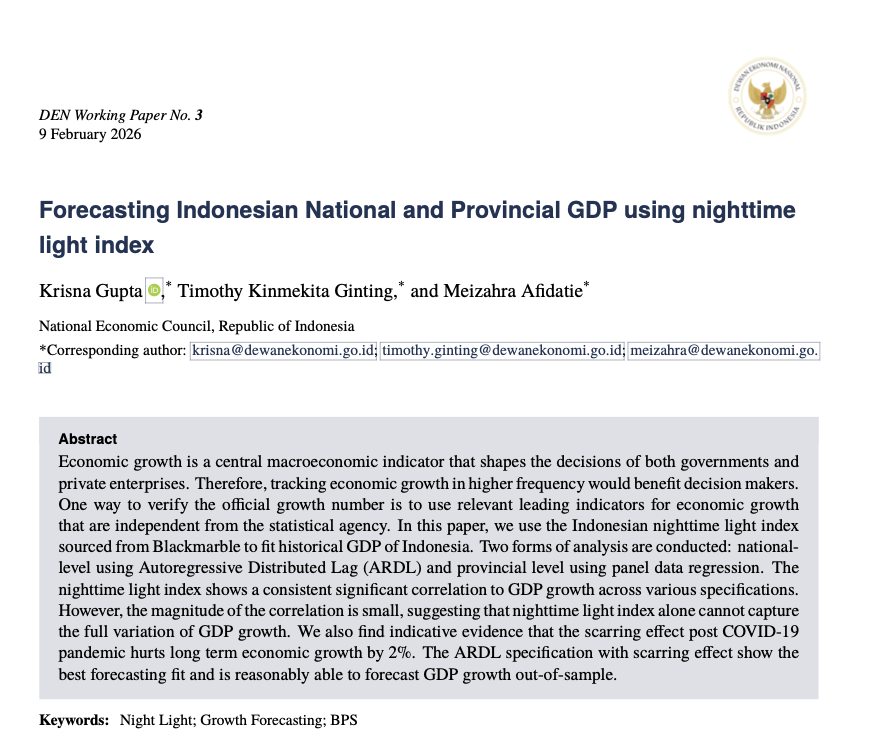
Economic growth is a key macroeconomic indicator that influences decision-making for both governments and private enterprises. Therefore, monitoring economic growth at a higher frequency would provide substantial benefits for policymakers and market participants.
One approach to validating official GDP figures is to utilize independent leading indicators that are not produced by the national statistical agency. In this paper, we employ the Indonesian Nighttime Light Index, sourced from Black Marble, to estimate and fit Indonesia’s historical GDP data.
Two analytical approaches are applied. At the national level, we use an Autoregressive Distributed Lag (ARDL) model. At the provincial level, we employ panel data regression techniques. The results indicate that the nighttime light index consistently exhibits a statistically significant correlation with GDP growth across various model specifications. However, the magnitude of the correlation remains relatively small, suggesting that nighttime light data alone cannot fully explain variations in GDP growth.
Furthermore, we find indicative evidence of a post–COVID-19 scarring effect that reduces long-term economic growth by approximately 2 percent. Among the estimated models, the ARDL specification incorporating the scarring effect provides the best forecasting performance and demonstrates reasonable accuracy in out-of-sample GDP growth predictions.